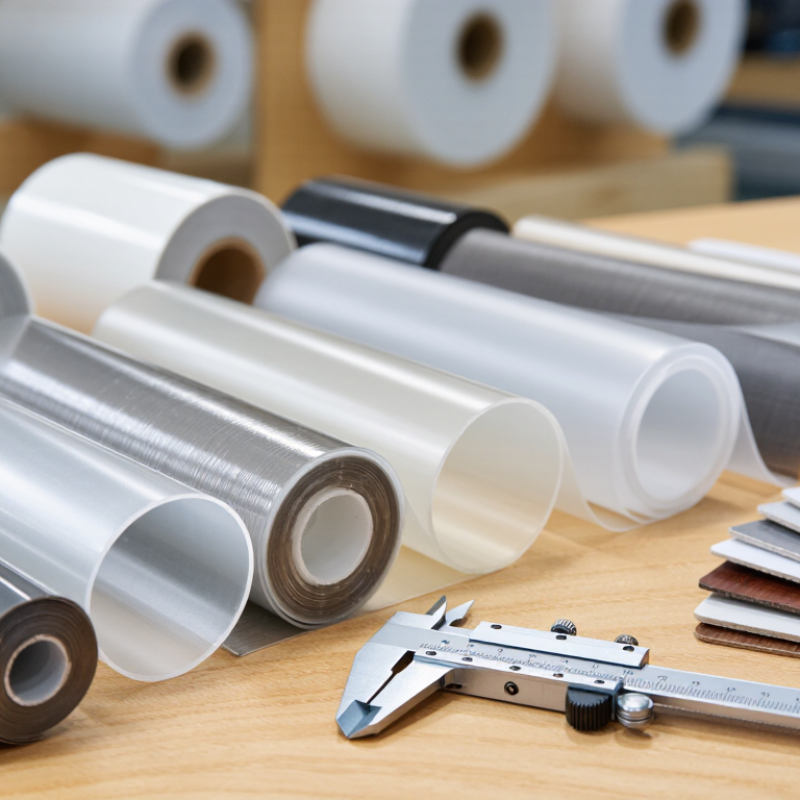
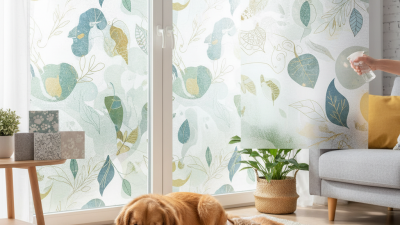
Choosing the right Pet Decorative Film from China requires more than comparing prices on a supplier website. The film must match your surface, design goals, production process, and long-term use. A glossy cabinet panel may need different performance than a textured wall application. Small details matter. Thickness, transparency, color stability, adhesive compatibility, and surface hardness can change the final result.
Dr. John R. Wagner Jr., a polymer-film researcher and author, has stated, “Film performance depends on the relationship between material design, processing, and real-world application.” This principle is useful when evaluating Chinese manufacturers. Ask for technical data, production samples, and test reports before placing a large order. Check the PET resin quality, coating uniformity, print clarity, release liner, and bonding strength. A sample that looks attractive under showroom lights may perform poorly after heat, moisture, or repeated cleaning.
Experience also reveals an uncomfortable point: the cheapest quotation is rarely the safest choice. It may hide thinner construction, unstable color batches, or weak quality control. Still, premium pricing does not guarantee excellence. Buyers should compare measurable specifications, not impressive claims. Visit the factory when possible, or request production videos and independent inspection records. Confirm minimum order quantities, lead times, packaging methods, and replacement policies in writing.
The best Pet Decorative Film supplier communicates clearly and welcomes technical questions. They should help you select the correct finish, not simply promote their largest catalog. A careful decision takes more time. That time protects your surface, budget, and brand reputation.
PET decorative film is a thin, printable surface material made from polyethylene terephthalate, usually called PET. It may include a primer, ink layer, texture, and protective coating. Unlike ordinary plastic sheets, it is designed to deliver color, gloss, grain, or stone effects with consistent thickness. Fortune Business Insights estimates the global PET films market at about USD 8.9 billion in 2023, with continued growth expected through 2032. This demand reflects packaging, electronics, interiors, and other technical applications.
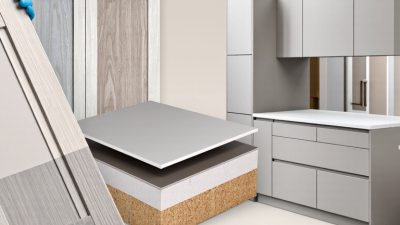
In interior projects, PET decorative film is commonly applied to cabinet doors, furniture panels, wall systems, doors, and elevator interiors. It can create a smooth matte surface that is easy to clean, but performance depends heavily on the coating and adhesive. When sourcing from China, request data for thickness, haze, tensile strength, abrasion resistance, and adhesion. ASTM D1003 supports haze testing, while ASTM D3359 can help evaluate coating adhesion. Suppliers should also provide color-control records and samples from different production batches.
A perfect sample can still mislead. I have found that gloss may change after forming, especially around sharp edges. Printed grain can also look slightly different under warm showroom lighting. Ask for finished-panel testing, not only film samples. Check moisture resistance, surface repair behavior, and indoor emissions from inks or adhesives. Reports from Grand View Research identify decorative surface materials as a steadily expanding interior market, yet choosing only by price remains risky. A lower-cost film may require better lamination equipment. That hidden cost matters.
How to Choose the Best PET Decorative Film from China?
Material properties decide whether PET decorative film survives production and daily use. According to a 2024 technical review from the European Polyester Film Association, oriented PET films commonly show tensile strength near 150–250 MPa. Check both machine-direction and transverse-direction values. A strong film can still tear during die cutting if elongation is poorly balanced. Measure it under ISO 527 or ASTM D882 conditions.
Thermal stability matters during lamination and forming. Industry technical data commonly place shrinkage around 0.5–2% at 150°C, depending on orientation and grade. Ask for the test temperature, exposure time, and direction. Otherwise, the number is incomplete. I once selected a glossy film that looked excellent under showroom lighting. It later curled near a heated edge. The missing detail was thermal shrinkage after processing. It was an avoidable mistake.
Optical and surface properties need equal attention. ASTM D1003 testing helps verify haze; clear decorative applications often target haze below 1%. Gloss, surface energy, and coefficient of friction affect printing, bonding, and feeding speed. Barrier performance also depends on coatings, not PET alone. Request oxygen and water-vapor transmission data, preferably from controlled laboratory reports. The 2023 Flexible Packaging Association sustainability report also highlights downgauging as a practical material-saving route, but thinner film reduces puncture resistance. A 12-micron sample may save material, yet fail around sharp corners. Test the actual design, not only a supplier’s certificate.
| Material Property | Typical Range for Decorative PET Film | Why It Matters | Recommended Test or Standard | Selection Guidance |
|---|---|---|---|---|
| Film Thickness | 12–250 µm, depending on the application | Controls stiffness, handling, dimensional stability, coverage, and converting performance. | Micrometer measurement; ASTM D374 or ISO 4593 | Use thinner film for laminating and label structures; choose thicker film when rigidity, impact resistance, or deep forming is required. |
| Tensile Strength | Approximately 150–250 MPa for oriented PET film | Indicates resistance to pulling, tearing during processing, and mechanical stress in use. | ASTM D882 or ISO 527-3 | Compare machine-direction and transverse-direction values because orientation can make strength anisotropic. |
| Elongation at Break | Usually about 60–150%, depending on orientation and grade | Affects flexibility, conformability, forming behavior, and resistance to cracking. | ASTM D882 or ISO 527-3 | Select higher elongation when the film must follow curves or tolerate bending; use balanced values for stable flat laminates. |
| Thermal Shrinkage | Typically below 1–3% at 120°C for dimensionally stable grades | Determines whether printed patterns, laminates, and overlays remain aligned during heat exposure. | ASTM D1204 or ISO 11501; test temperature and time must be specified | Choose low-shrinkage film for thermal lamination, hot stamping, appliance panels, and precision graphics. |
| Haze | Clear grades: commonly below 1–3%; matte grades may be substantially higher | Affects transparency, image sharpness, depth of appearance, and visual uniformity. | ASTM D1003 or ISO 14782 | Use low-haze film for clear decorative windows and high-resolution graphics; select controlled haze for soft-touch or frosted effects. |
| Gloss at 60° | High-gloss surfaces often exceed 80 GU; matte surfaces may be below 30 GU | Influences color perception, reflection, fingerprint visibility, and the final decorative effect. | ASTM D2457 or ISO 2813 | Specify the gloss angle, measurement direction, and acceptable tolerance because surface texture changes the result. |
| Surface Energy | Untreated PET is commonly around 42–48 dyn/cm; coated or treated surfaces may be higher | Determines wetting and adhesion of inks, coatings, laminating adhesives, and primers. | ASTM D2578 dyne solution test or contact-angle measurement | Confirm the treated side, treatment level, aging behavior, and ink or adhesive compatibility before mass production. |
| Adhesion Strength | Application-specific; many pressure-sensitive constructions target at least 10–20 N/25 mm after conditioning | Prevents lifting, edge peeling, bubbles, and delamination from the target substrate. | ASTM D3330 for peel adhesion; ASTM D3359 for cross-hatch coating adhesion | Test on the actual substrate, including plastics, painted metal, glass, wood, or boards, under expected temperature and humidity. |
| Coefficient of Friction | Often approximately 0.25–0.60, depending on surface finish and additives | Affects feeding, stacking, rewinding, die cutting, and automated application. | ASTM D1894 or ISO 8295 | Choose a controlled friction level to reduce slipping, blocking, wrinkles, and feeding errors during converting. |
| Service Temperature | PET has a glass-transition temperature near 67–81°C; practical use limits depend on the adhesive and coating system | Determines resistance to softening, distortion, shrinkage, and adhesive failure during use. | DSC: ASTM D3418; dimensional stability: ASTM D1204 | Evaluate the complete construction, not PET alone, when the product will face sunlight, heating, refrigeration, or repeated temperature changes. |
| Chemical and Moisture Resistance | Generally good resistance to water, dilute acids, oils, and many solvents; performance depends on the coating and adhesive | Protects printed graphics and decorative surfaces from cleaning agents, stains, humidity, and handling. | ISO 2812 for liquid resistance; ASTM D543 for chemical resistance | Test the actual chemicals, concentration, contact time, temperature, and rubbing method expected in the final application. |
| Light and UV Resistance | No universal value; performance varies with pigments, inks, UV absorbers, and protective coatings | Controls fading, yellowing, embrittlement, and loss of appearance during outdoor or high-light exposure. | ASTM G155 or ISO 4892-2 for accelerated weathering; ISO 105-B02 for colorfastness | Require exposure conditions and acceptance criteria that match the intended indoor or outdoor service life. |
| Flammability | Must be specified by the finished construction; untreated PET is not automatically flame-retardant | May be required for transportation, electrical, building, or public-space applications. | UL 94, EN 13501-1, or another regulation applicable to the end use | Confirm the required classification for the complete film, adhesive, liner, and substrate assembly. |

Note: The ranges shown are typical reference values for oriented PET decorative-film constructions. Actual specifications vary by thickness, orientation, surface treatment, coating, adhesive, and test conditions. Always confirm the supplier’s technical data sheet and approve a production sample before ordering.
Choosing the best PET decorative film from China begins with supplier evaluation, not a glossy catalogue. I would request the factory address, production-line video, recent test reports, and batch-traceability records. A capable manufacturer should provide PET thickness tolerance, haze, gloss, tensile strength, coating adhesion, and thermal-shrinkage data. Ask for evidence.
Independent laboratory testing matters. Confirm that the submitted sample matches the proposed mass-production material. A 0.05 mm thickness difference can affect forming, lamination, and edge appearance. Request samples from at least three production batches. Review the results with a qualified technician, not only a salesperson. ISO 9001 supports process control, but certification alone proves little. Audit corrective-action records and calibration dates. A supplier should also explain resin sources, coating chemistry, storage humidity, and shelf life. Small details often expose weak control.
Sustainability deserves practical scrutiny. The OECD Global Plastics Outlook reports that global plastic production rose from 234 million tonnes in 2000 to 460 million tonnes in 2019. Ask whether the supplier measures scrap, reuses edge trim, and documents recycled content claims. Do not accept vague “eco-friendly” language. A 2024 PET film market report from Grand View Research projects continued market growth through 2030, increasing pressure on capacity and delivery reliability. Check lead times during peak months, minimum order quantities, packaging protection, and replacement terms. I would not rely on the lowest quotation. A factory may offer excellent samples yet struggle with color consistency after 10,000 square meters. Test the finished panel. Allow room for doubt.
How to Choose the Best PET Decorative Film from China?
Which Quality Standards and Tests Should You Verify?
A reliable PET decorative film should have clear technical data, not only attractive samples. Check film thickness, width tolerance, surface gloss, color difference, and backing uniformity. Ask for the test method behind every value. ISO, ASTM, or EN methods may produce different results. Therefore, compare reports using the same standard.
Adhesion testing is essential after lamination. Request cross-cut or peel tests, especially for furniture panels and interior surfaces. Tensile strength and elongation reveal whether the film can survive cutting, bending, and installation. Heat-aging tests should simulate actual production conditions. A practical check uses controlled heat, pressure, and time. Then inspect bubbling, shrinkage, discoloration, and edge lifting.
Do not ignore chemical resistance. Test common cleaners, alcohol, oils, and moisture on the finished laminate. For building applications, verify fire-performance requirements for the target market. UV exposure testing also matters when sunlight reaches the surface. Ask for laboratory reports, sample identification, testing dates, and batch traceability. An accredited independent laboratory offers stronger evidence than an unchecked internal sheet.
A glossy sample can mislead.
One common sourcing mistake is testing only a small sample. Production variation may appear later. Compare samples from different batches, and keep a sealed reference piece. Also review storage conditions, roll packaging, and transport protection. In practice, these details can affect performance as much as the resin itself. No single test proves quality. A balanced verification plan is safer.
How to Choose the Best PET Decorative Film from China?
Price comparisons should begin with the landed cost, not the quoted roll price. A supplier may offer USD 2.10 per square meter, but freight, tooling, protective packaging, and import duties can change the result. Grand View Research estimates that the global PET film market was worth about USD 39 billion in 2023, with steady growth expected through 2030. This demand creates many suppliers, but quality levels still differ. Request the film thickness, roll width, coating structure, minimum order quantity, and waste allowance in writing. A cheaper film may wrinkle during lamination or show uneven gloss under showroom lighting.
Customization needs measurable standards. Ask for color samples, surface texture references, fire-performance documents, and a tolerance for color difference, such as ΔE. For woodgrain or stone patterns, approve a physical sample before mass production. Digital proofs can mislead. I learned that small changes in PET thickness can affect folding, adhesion, and edge appearance. The Association of Plastic Recyclers also emphasizes clear material identification and design choices that support recycling, although decorative structures may require special evaluation. Do not assume every “eco” claim means the same thing.
Delivery terms deserve equal attention. Confirm production time, sample time, shipping method, Incoterms, inspection rights, and the remedy for late delivery. A practical purchase order can link final payment to inspection results and approved samples. The World Bank’s Logistics Performance Index shows that international shipment reliability varies greatly between markets. Build a buffer of seven to fourteen days for port delays. That may feel excessive. It is often cheaper than stopping a production line.